Start with the working vehicle
Write down the intended use before comparing lift kits. A vehicle carrying camping equipment over corrugations needs a different compromise from a lightly loaded trail vehicle negotiating slow cross-axle obstacles. Include regular road journeys, towing and the need for predictable emergency handling in that description. A modification that improves one obstacle can make the daily vehicle worse.
Measure front and rear axle loads with the normal occupants, fuel, tools and luggage aboard. Compare those readings with the manufacturer’s gross vehicle and axle limits. A public weighbridge can provide useful evidence, provided the weighing method is suitable. Springs do not increase the vehicle’s legal carrying capacity, and a level stance does not prove that an axle is within its limit.
Record ride heights using repeatable points on level ground, along with tyre sizes, cold pressures and existing accessories. Check bushes, ball joints, wheel bearings, mounting hardware and damper leaks first. Worn parts can disguise the original problem and make comparisons between old and new suspension misleading.
Separate spring support from damping
Springs support the vehicle and influence where it sits within its available travel. Dampers control the speed of suspension movement. A stiffer spring is not automatically a cure for repeated bouncing, and a heavily damped shock cannot make an unsuitable spring carry the right load. Match each component to its job rather than using ride height as the only success measure.
Permanent accessories belong in the baseline load. Occasional cargo is a different problem: a spring selected around maximum expedition weight may ride poorly when the vehicle is empty. Discuss the expected load range with a competent suspension supplier and ask what compromises the proposed spring and damper combination makes at either end.
| Change | Possible benefit | Required check |
|---|---|---|
| Higher spring rate | More support under a defined load | Empty ride, droop and component suitability |
| Longer damper | Potentially more controlled movement | Compressed length, mounts, hoses and joints |
| Increased ride height | Selected body or chassis clearances | Alignment, stability and driveline angles |
Check the full movement envelope
At compression, the bump stops should manage the intended limit before an unsuitable component becomes the stop. At extension, brake hoses, ABS wiring and driveline joints must not be stretched or forced beyond their intended operating range. Damper length, spring retention and anti-roll-bar movement all need consideration. These checks require appropriate workshop equipment and safe support procedures, not an improvised jack test.
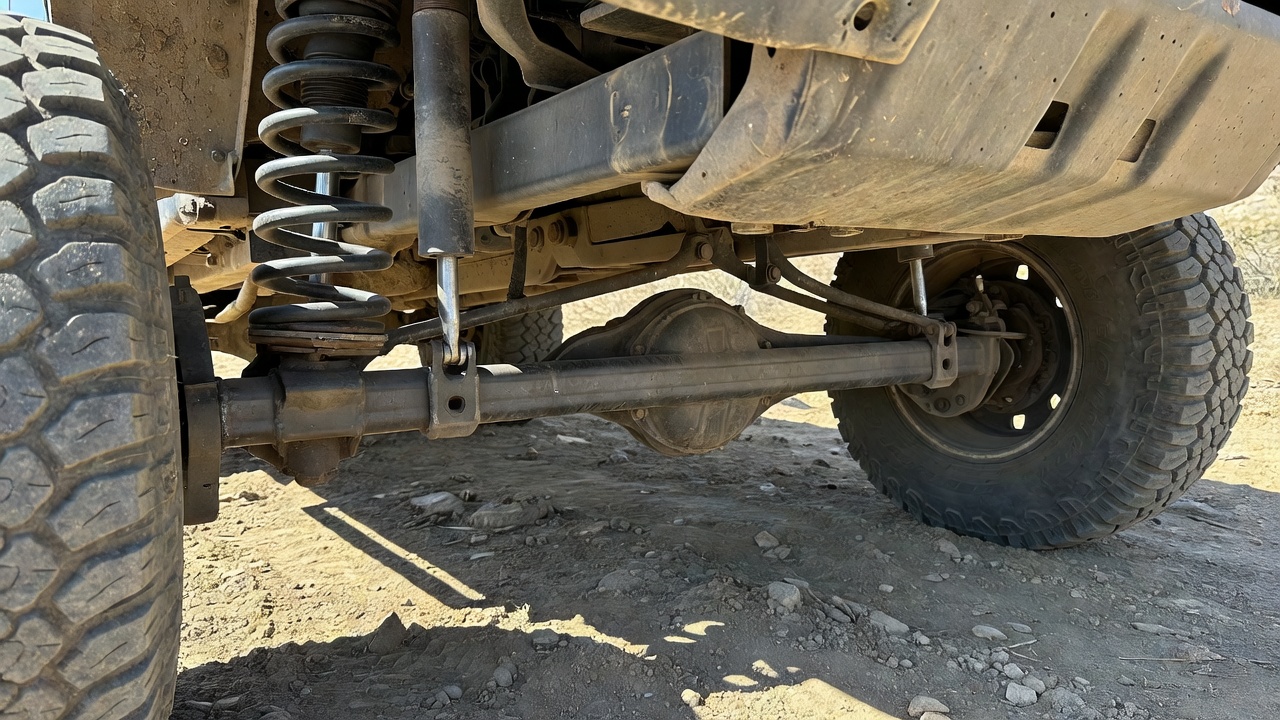
A suspension lift on a live-axle vehicle does not, by itself, raise the axle housing’s lowest point. Larger tyres may change that clearance, but they also affect gearing, braking and packaging. On independent suspension, changing static height can reduce available droop and alter joint angles. These differences are why universal lift-height recommendations are unreliable.
Alignment may require more than setting toe. Caster, camber where adjustable, axle centring, steering linkage relationships and driveshaft angles can all be affected. Obtain model-specific procedures and approved component information. Toyota Land Cruiser, Jeep Wrangler and Land Rover Defender variants, for example, do not share one suspension geometry or one correction method.
Add protection without hiding the cost
Underbody plates, rock sliders and replacement bumpers add mass, sometimes well ahead of or behind an axle. Include the complete installed equipment in your axle-load assessment. Check that mounting points are appropriate for the intended load and that the protection does not contact steering, exhaust or moving suspension components.
Inspect service access, drainage and cooling. A guard that retains mud around hot components or prevents inspection of a leak can create an expensive secondary problem. After installation, verify clearances through the approved movement checks and recheck fasteners at the intervals specified by the component manufacturer. Protection is successful when it preserves function, not merely when it looks substantial.
Validate the result methodically
Begin with inspection and alignment, then use a conservative, controlled assessment consistent with local law and the workshop’s advice. Record the same loads, pressures and ride-height measurements used for the baseline. Note harshness, repeated oscillation, steering changes and unusual noises rather than judging the result solely by appearance.
Change one relevant variable at a time when troubleshooting. If the vehicle develops vibration after a lift, consider driveline geometry as well as wheels and tyres. Stop driving if there is looseness, interference, impaired braking or unstable steering. A documented inspection is more valuable than another untested part.